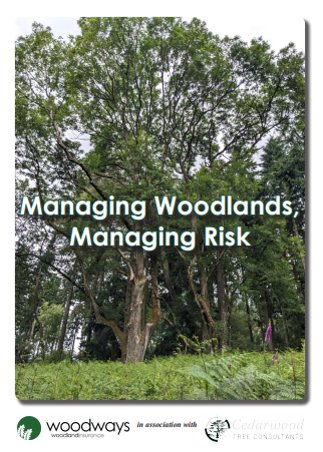
Managing Woodlands, Managing Risk

View, Download and Share as a PDF

Learn how woodland owners can meet their Duty of Care by managing tree safety, boundaries, and site access. Discover survey types, legal responsibilities, and the benefits of a Site Management Plan.

Duty of Care for Woodland Owners

As a landowner, the woodland owner has a Duty of Care to both visitors to the site and passers-by and neighbors.


Key Issues Worth Considering

  • Checking whether the boundaries of your site are clear and secure.

  • Identifying whether your woodland shares a boundary with a road, public right of way (PROW), or other properties. Trees within falling distance of these have the potential to cause problems.

  • Assessing the woodland’s accessibility/vulnerability to trespass:

    • Is the boundary fence robust and fit for purpose?

  • Checking whether any footpaths within the site are clearly defined and hazards such as:

    • Surface roots

    • Uprooted trees

    • Lower branches
      …are minimized.

  • Checking whether the mix of tree species are known/plotted and if their condition has been surveyed.


Understanding the Risks

  • Risks within woodlands are usually low, and many woodland owners can enjoy their woodland without concerns.

  • However, risks do exist. Being informed helps manage the risk and minimize the potential for claims or accidents.

  • If a claim is made (whether it has merit or not), evidence of a tree/woodland condition survey can be very beneficial in presenting a defense.


Changes in Duty of Care

The Duty of Care of the owner can change depending on how the site is used:

  • Guests invited to the site

  • Site owned by a business

  • Visitors who pay to visit

This includes:

  • Forest schools

  • Forest activity centers

  • Quad bike usage

  • Crafting events

  • Selling firewood

A Site Management Plan (SMP) can help identify tree safety and areas of activity, which supports zoning for risk management.


What Level of Survey?

A tree safety survey is different from one that assesses timber value or ecological impact.

A tree safety and condition report assesses:

  • Is the tree in good condition with good vigor?

  • Is it safe?

(Timber assessment focuses on value.)


Types of Surveys

  • A basic boundary walk-by safety survey, noting any safety concerns, with a written summary.

  • A site-wide walk-by safety survey, noting any safety concerns, with a written summary.

  • A detailed site-wide safety survey, noting key features within the site.

  • A detailed site-wide safety survey and Woodland Management Plan.


Frequency of Surveys

  • Formal guidance is limited.

  • General principle: there should be evidence of a survey within the past five years, and depending on species/setting, re-inspections every 1–5 years.

  • Greater frequency is required where there is a target, such as a highway or residence.

  • A baseline survey is invaluable when unforeseen events such as storms occur.


Benefits of a Site Management Plan (SMP)

  • Provides recommendations and priorities for tree works — helpful for scheduling and budgeting.

  • Identifies species vulnerable to specific diseases (e.g., ash, larch, alder) with management suggestions, including species diversification.

  • Identifies species like hazel for coppicing (for habitat enhancement or harvesting).

  • Assesses species diversity and spacing, helping to enhance natural undergrowth and optimize growing space.

  • Allows active management of dead timber in a safe and sustainable way:

    • Identifies existing veteran trees

    • Guides veteranization for habitat creation

  • Provides guidance on obtaining:

    • Tree work consents (from the Local Planning Authority – LPA)

    • Felling licenses (from the Forestry Commission – FC)

    • Grants for tree works, depending on the context


Qualifications of Surveyors

  • Check the level of training your woodland surveyor is accredited to.

  • Look for qualifications in arboriculture/urban forestry (level 4 minimum).

  • Additional training may include:

    • Professional Tree Inspector (PTI)

    • Tree Risk Assessment Qualification (TRAQ)

    • Quantified Tree Risk Assessment (QTRA)


In-House Team Support

  • It’s useful to have a member of your own local team trained in:

    • Basic Tree Surveying and Inspections (BTSI)

  • This ensures regular assessments between professional surveys.


Services from Cedarwood Tree Consultants

Cedarwood Tree Consultants have a team of specialists trained in surveying trees and woodlands.
Our reports can:

  • Provide reassurance for you and your insurance provider

  • Inform future management and budget allocation

  • Training in BTSI for your own team is also available by arrangement.


Contact Details

Woodways Woodland Insurance
(in association with Fiveways Insurance Group)

Stafford Office
1 Newport Road, Stafford, Staffordshire ST16 2HH
📞 01785 251790 / 0333 9966 220
✉️ stafford@fivewaysinsurance.co.uk
🌐 www.fivewaysinsurance.co.uk

Newport Office
51 High Street, Newport, Shropshire TF10 7AT
📞 01952 812380 / 0333 9966 220
✉️ enquiries@fivewaysinsurance.co.uk
🌐 www.fivewaysinsurance.co.uk


Cedarwood Tree Consultants
3 Howton Grove Barns, Wormbridge, Hereford HR2 9DY
📞 01981 570426 / 07888 838360
✉️ enquiries@treeconsultants.org.uk
🌐 www.treeconsultants.org.uk


Lorem ipsum dolor sit amet, consectetur adipiscing elit. Ut elit tellus, luctus nec ullamcorper mattis, pulvinar dapibus leo.